|

Cu Chi Vietnam – “Tuck, listen to me.
You can make it back to Cu Chi - you can and you will - I’ll help you.”
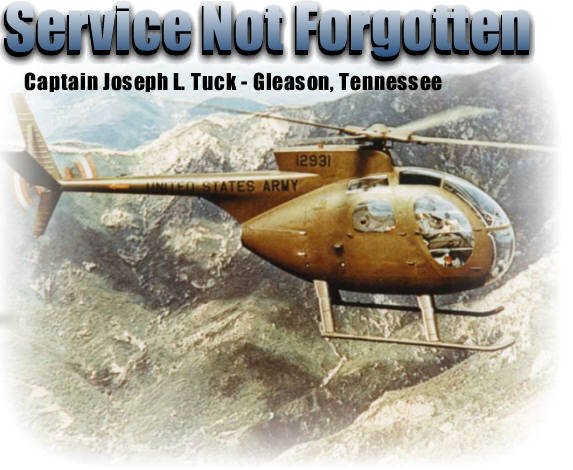
These words, crackling over the air waves to a wounded pilot of B Troop, 3d
Squadron, 17th Air Cavalry, helped to bring a dramatic helicopter mission to
a successful completion.
The flight
started out as just another routine observation mission for the pilot of the
OH-6A Cayuse helicopter, Captain Joseph L. Tuck of Gleason, Tenn., and his
observer, Private First Class Richard Edwards of Polkton, N.C.
Following them in
a Cobra helicopter gunship were Warrant Officers William Kane and John A.
Garrison, key figures in the drama awaiting the hunter-killer team as the
two helicopters’ headed for the Saigon river 27 miles northwest of Saigon.
Under operational
control of the 25th Infantry Division, their mission was to observe and
engage enemy troops along the vital waterway leading into the nation’s
capital.
Captain Tuck
skimmed above the ground in his observation helicopter as the Cobra circled
overhead. On a particularly low pass over the lush growth near the river
bank, his rotor wash uncovered a camouflaged tunnel entrance.
Tuck banked his
helicopter around for another pass and flew into a barrage of intense
automatic weapons fire. One burst ripped through the cockpit hitting Tuck
in the left leg, smashing two bones. Edwards was hit in the right leg and
began bleeding heavily.
Unable to move
the rudder pedals with his wounded leg, Tuck gave the controls of the
damaged, but still flyable ship, to his observer. Edwards, already pale from
shock and loss of blood, turned the ship towards the Cu Chi base camp 10
miles south.
Having
unsuccessfully attempted to stop the heavy flow of blood from his wound,
Tuck looked towards Edwards in time to see the PFC slump over the controls
and throw the Cayuse into a suicidal plunge.
With rapidly
failing strength, Tuck managed to pull the observer off the controls and
recover the tiny Cayuse. He then got on the radio and called the Cobra for
help.
Inside the
Cobra’s cockpit, Garrison of Fayetteville, N.C., listened to the message and
thought it over. Tuck said he wanted to land his ship. If he somehow
managed to set the craft down without crashing, there was still no way the
two-seater Cobra could pick up the two men from the jungle where a large
number of Viet Cong troops were lurking.
Turning the
controls over to Kane, from Fort Worth, Tex., Garrison said a silent prayer
and began speaking slowly and firmly to Tuck. “You
must not land. Tuck, listen to me. You can make it back to Cu
Chi. You can and you will - I’ll help you.”
Haltingly, Tuck’s pain-racked mind started responding to Garrison’s
encouragements and instructions. |
|
 Tuck, very weak from loss of blood, could not
follow complicated flying instructions so Garrison gave him simple
directions. Tuck, very weak from loss of blood, could not
follow complicated flying instructions so Garrison gave him simple
directions.
“Turn left Tuck.
A little more . . . that’s it, keep going . . . OK. Now pull up Tuck. Pull
up on the cyclic, you’re too low!”
Slowly the Cayuse
gained altitude and the Cobra moved into a position directly above and
behind the stricken craft. In that manner the two helicopters flew back to
Cu Chi.
At one point the
blood from Tuck’s leg shorted out the radio next to his seat and a hurried
change to another set was made.
As the Cobra
approached Cu Chi, Garrison called the tower and told them he was escorting
in a crippled helicopter. Crash rescue trucks raced across the steel plates
to take up standby positions near the landing strip while the traffic
controller cleared the skies to give the crippled Cayuse every possible
chance.
Tuck radioed one
last message before concentrating all his remaining strength on landing the
ship, “I’m going to bring her in on a sliding landing, wish me luck.”
The Cobra
pilots, realizing that he was
going to slide along the runway on the helicopters’ skids instead of trying
to drop the craft straight down, kept their eyes glued to the Cayuse and
waited. There was nothing more they could do.
Wobbling
erratically, the Cayuse plummeted towards the ground. Several feet above
the runway the helicopter flared up and swerved wildly to the left.
Garrison held his
breath, sure that the tiny ship would flip over and disappear in a mass of
flames.
At the last
moment Tuck straightened the ship out and dropped it softly to the ground.
Too weak to lift his arms and twist the knobs to shut off the engine, he
grasped the handle of the emergency fuel cut-off and yanked it up before he
collapsed.
Tuck remembers
nothing of those last few minutes, but Kane, leaping out of the Cobra almost
before it touched the ground was the first one to reach the craft. Feebly,
Tuck motioned him towards the observer. The captain would not let anyone
help him until Edwards was pulled out of the Cayuse.
In a war where
supersonic jets have replaced the single engine bi-plane and
“seat-of-the-pants” flying, the last outpost where courage and skill are the
deciding factors is in the helicopter war over Vietnam.
Shortly after the
historic mission Captain Joseph Tuck was awarded the Distinguished
Flying Cross for gallantry.
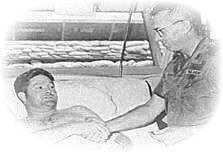
Captain Joseph Tuck receives the
Distinguished Flying Cross from Colonel James Smith, Deputy Commander of the
1st Aviation Brigade. |