|

Gleason Industries: A Look Back
Back to Main
Gleason History Page
The History of Clay in Gleason
The first clay was dug in 1926, from a testing on the Crawford farm. In a 1928 issue of the Enterprise this account of the clay deposit was given:
On the W.R. Crawford farm two miles west of Gleason, an accident, so the story
goes, happened. A tenant on the farm of Mr. Crawford desired to run a cross
fence on the farm and, of course, the landlord came out to help locate it.
It seems there was a spring on the side of a bluff; and when he examined the
spring water, it indicated a clay deposit. He had the place examined and found
one of the richest veins of clay ever located in this section. The clay
mine took in some twenty acres of the very best variety of clay. Almost
overnight the Bell Clay Co. started operation. A large crew of men, some 25,
were put to work, and the new find was soon being hauled to Gleason then
shipped. The method used to get at the clay was as follows:
Brush was cut and dirt was moved by means of pond scoops pulled by a team of
horses. After the dirt was removed, holes were drilled approximately three feet
in depth, with hand augers to insert the dynamite. Noah Doran was in charge of
the dynamiting. After blasting, workers dug the clay out with picks and shovels,
and placed it by hand on the platform. Two Model-T Ford trucks, owned and
operated by Alvert Trevathan, hauled the clay to what was called the "gin" siding
on the railroad north of town, where the offices of Bell Clay Company were
located in later years. Ivo Edmonston was in charge of moving the dirt. Some of
the other workers were Fate Vaughn, as Supervisor and co-owner with Bell, Wade
Parks and Carlos Trentham. The best variety of clay always had a layer of
lignite between the dirt and clay.
Kelly Finch discovered clay on his land in 1927. He was digging a square wooden
curbed well to water his livestock when he hit clay and had difficulty digging
further. Mr. Finch was an inquisitive man, so he drilled test holes to find the
extent of the mineral on his farm. Satisfied that there was minable clay, he
proceeded to open a mine with seven or eight teams of two mules to a pond scoop.
At about this time he started for Zanesville, Ohio, with a suitcase full of clay
samples for testing. On the way the train porter, a former employee of the
Spinks Clay Company, picked up the heavy suitcase, and upon finding what the
contents were, suggested that Mr. Finch go to Cincinnati, home of the famous
Rockwood Pottery. Upon arriving in Cincinnati, the clay was tested and found to
be superior in quality. Spinks Clay Company started to mine the land in 1930.
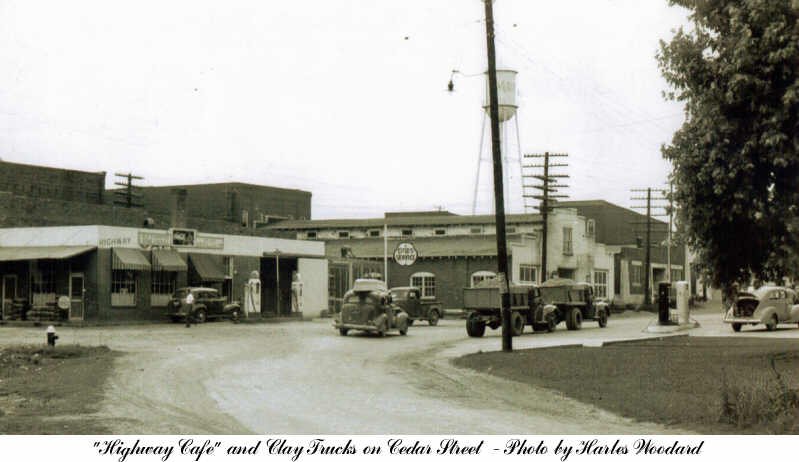
The clay industry continued to grow until, in 1970, there were five clay mining
companies whose combined daily shipment totaled 600 tons of clay. A sign erected
on the edge of Gleason's city limits reads:
"Welcome to Gleason,
Ball Clay Mining Center of the Nation"
This mineral has its richest and greatest deposits here in West Tennessee
- and especially in Weakley County.
Since this clay is of the finest grade, it is used in making a very find grade
of china and porcelain ware, as well as pottery. This is a very brief
history of the mining of clay in Gleason since its discovery in 1926 to the
present. There are currently four clay mines operating: Old Hickory,
Kentucky-Tennessee, Spinks, and Cypress.
THE BRICK INDUSTRY
Around 1910, a brick plant was established by several local businessmen on the
Charlie Overton land near the corner of Jeans Mill road and East Union streets.
Bricks were made there and used to build a number of buildings that are still
standing, including the old corner store building (next to City Drug Store), the
Dr. Jeter house, the E. L. Lemonds house (both on College street.), the Jeff
Parks house on West Street, and the Will Malone house (now Harvey Morris' house)
on Hopewell street.
Gleason Clay Products, a subsidiary of Bush Brick of Nashville, was established
on the old Dresden Highway in 1960. In 1986, it became the Gleason Brick
Division of Merry Company of Augusta, Georgia. It is a part of the largest brick
manufacturer in the world, Boral Industries Incorporated of Australia. The
local plant currently employs eighty-one people and manufactures a daily average
of 164,736 bricks.
THE Gleason Foundry
In 1933, the Gleason Foundry Company was established as a partnership by W. F. Trevathan, Ellis F. Trevathan, and J. T. Forrest (who claimed to be a direct
descendent of Nathan Bedford Forrest). It was for the manufacture of grey iron,
brass and aluminum castings. They supplied, among others, castings for
narrow-gauge rail equipment used in the local ball clay mines in West Tennessee
and Kentucky.
During the mid-thirties, the Gleason Foundry became involved in the development
of clay shedding equipment for the local clay industry. This has continued and
grown considerably and consistently through the years.
In the early days of World War II, the casting operation was suspended. It was
never re-established due to the fact that after the war Gleason
Foundry began to manufacture the Gleason Shredder in its earliest configuration;
some of the basic designs of which are incorporated into the present day models.
Their history has been one of continuous experimentation, research, and
development in an effort to produce the most efficient, versatile, and
maintenance-free reduction unit possible. These clay shredders are sold
nationwide as well as in a number of foreign countries.
Gleason Foundry was incorporated in 1966. In 1987 Ellis Frank Trevathan serves
as Chairman of the Board, and his son Frank Trevathan serves a President. They
currently have twelve employees.
Gleason's Post office
Gleason's first Post Office was established in 1851 in a corner of John
Hamilton's general store. He was the first Postmaster and remained in that
capacity until the summer of 1861.
The second Post Office was located under the hotel building until 1936 when it
was moved to the corner building previously occupied by the Farmers and Citizens
Bank and Hawks Cafe (where the Resale Shop now is).
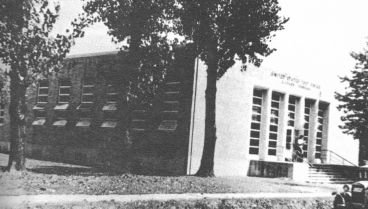
In 1939, a large modern Post Office building was erected at 101 Cedar Street at
E. Main. The reason a community the size of Gleason has the large Post Office
building is in large part due to the sweet potato plant business whose shipments
increase the volume of mail handled through the Post Office.
The list of Postmasters from 1851 to the Present (1986) include:
The list of Acting Postmasters includes:
-
Kathleen Wright
-
Pete Taylor
-
Toby Bell
-
Lewis Terrell
Bob S. Wray is the present (1986) Postmaster, having been appointed in 1961.
THE Old Depot
In the 1913 and 1914 issues of the "Gleason Herald", the following timetable for
Eastbound and Westbound trains on the N. C. and St. L. Railroad was scheduled.
| # 1
Dixie Flyer 5:07 A.M. |
# 2
Dixie Flyer
11:27 P.M. |
| # 3
Dixie Flyer 4:25 P.M. |
# 4
Dixie Flyer
11:29 A.M. |
| # 53
Dixie Flyer 2:42 P.M. |
# 52
Dixie Flyer
5:15 A.M. |
| # 55
Dixie Flyer
9:04A.M. |
# 54
Dixie Flyer
6:36 P.M. |
All trains were met by local citizenry for the fellowship and to see who was
arriving and departing. Even church services were dismissed for the noon trains.
At this time W. V. Overall was the Depot agent.
In the 1913 and 1914 papers, N.C. and St. L. railroad advertised a round trip to
Nashville for $2.00, so when planning your summer vacation, don't overlook any
of the following low fares:
|
Round Trip
Martin to Chicago, Illinois
$18.00
Round Trip
Martin to Louisville, Kentucky 11.30
Round Trip
Martin to Cincinnati, Ohio 16.30
Round Trip
Martin to St. Louis, Mo. 9.50
Round Trip
Martin to New York City, N.Y. 40.30 |
Another advertisement in the May 23rd, 1913 Herald advertised:
"Let's Everybody Get Ready to Give the Nashville Boosters a Big Blow-out When
They Arrive Here." This will not only boost our little town, but will be quite a
treat for all to see them and their fancy train.
Some of the early agents were Tom Cooper, Tom Butler, W. V. Overall, and Mr.
McDonald. A familiar sight in the twenties and thirties was Marion Gibbs, a much
loved black man, pushing the small mail cart from the trains to the Post Office.
Also Leonard Brawner picked up packages at the Depot and delivered them around
town for $0.25 per delivery.
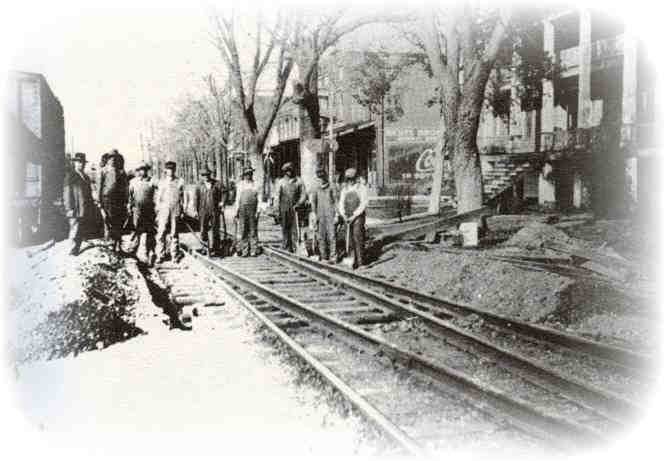
Section hands working on railroad in front of the Whitworth
Hotel in the early 1920's
The Depot was torn down in 1970 or 1971, much to the displeasure of many of us
who had fond memories of the time spent there. A metal building was moved onto
the site to do railroad business, with L. L. Bennett as Agent. Following Mr.
Bennett's retirement, other agents who took over were Mr. Rogers, Mr. Sylvis,
and Frank Cequin.
The metal building was removed in 1984, since Gleason no longer had a through
train to Dresden. The few freights which run through the town each week only go
to the Clay companies and to Krueger-Ringler where they turn around.
Telephones in Gleason
 The
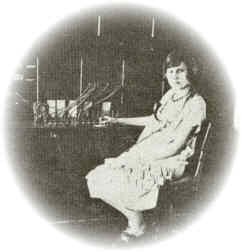
Rural Telephone Company, nicknamed the p-vine, had its switchboard upstairs over
the Farmer's and Citizen's Bank on the corner of Front and Main streets facing
the railroad. From 1908 to July 1912, Clarence and Bulah Horn lived there
in full charge of the switchboard, repairing lines, etc. at a salary of $35 per
month paid by George Brummitt, with A. W. Carroll as Secretary. Others who
operated this telephone system were J. Cleatus and Zela Trevathan, Ambus and
Willie Stoker, Jenny Taylor, Florence and J. R. Kelly, and Louisa Stigall. The
Rural Telephone Company, nicknamed the p-vine, had its switchboard upstairs over
the Farmer's and Citizen's Bank on the corner of Front and Main streets facing
the railroad. From 1908 to July 1912, Clarence and Bulah Horn lived there
in full charge of the switchboard, repairing lines, etc. at a salary of $35 per
month paid by George Brummitt, with A. W. Carroll as Secretary. Others who
operated this telephone system were J. Cleatus and Zela Trevathan, Ambus and
Willie Stoker, Jenny Taylor, Florence and J. R. Kelly, and Louisa Stigall.
The Cumberland Telephone System was located over Fowler's Grocery and the
Brundige Produce Building (where Gleason Hardware and Appliance is now located).
Some operators of this system were Mattie Buntin, Mable and Mack Smyth, Zelphur
Steward, Vergie Sims, and Lubie Stalcup.
\
In the 1950's, Southern Bell installed a dial system, when Jess Margrave was
Mayor. In 1960, direct dialing or 1 plus was introduced to Gleason Residents.
The switchboard was located in the Margrave building on Cedar Street. A new
telephone building to house the dialing equipment, was build by South Central
Bell in the 1970's on Jeans Mill Road. [Scroll down for story about Hugh
Gordon Stoker, of the famed Jordanaires and his early beginnings in the Gleason
Switchboard office.]
Electricity in Gleason
Electricity came to Gleason in 1916, and Clarence Horn operated the first light
plant, which was located on the old hitching lot. The current was only turned on
one day per week and certain hours at night.
The Gleason Opera House had electricity which they got from privately installed
dynamos across the street. The Opera House was located on the second floor
over the Ammon's Drug Store and seated 400 people. Touring stock companies
appeared here, with the outlaw, Cole Younger, once a guest. Moving pictures were
shown there three time a week.
Gleason is now served by Weakley County Municipal Electric System with main
offices in Martin, Tennessee.
The Funeral Business
Mr. John Shipley was the first Undertaker known of in this area. He started his
business sometime in the early 1900's. He had a store building on Main street,
near Gleason Hardware, where he stored the caskets. Bodies were prepared and
kept in the homes of the families until funeral time. Rob Cravens drove the grey
horses that pulled the hearse. It was also Mr. Shipley who later had the first
motor ambulance here. In front of his building, his wife, Mattie, had a
millinery shop. The Shipley's lived in a house where the Lucille Smyth home now
stands.
In about 1920, S. D. (Sam) Summers (who was also the local Veterinarian) moved
to Gleason with his family where he continued to live and practice until he was
disabled in 1940 and Ned Castleman went into the undertaking business. It was
called the Gleason Undertaking Company. The hearse was pulled by a pair of
beautiful white horses. After several years they bought a motor hearse which
also served as an ambulance. It was driven by Sam Summers' son, Leon Summers. In
later years the business was continued with Dr. Dave Terrell as a partner.
George Barrix also assisted in the business.
In 1935, F. L. Maddox began his career in the Undertaking business. He first
managed the business for Winstead and Jones, who had an office in Gleason.
Later, they sold the business to Bowlin and Riggs of Dresden (Jim Bowlin and M.
F. Riggs) and managed by F. L. Maddox.
In the 1940's, F. L. Maddox and his brother, J. H. Maddox, became partners
with Bowlin and Riggs. At that time F. L. Maddox became General Manager of
Maddox and Company Burial Association. Some of Mr. Fitz's employees were
Warren Maddox, Joe Willard Aylor, Jewell Simms, and Jewel Phelps. He continued
in this position until his health forced him to retire in 1964. At this
time S. T. Bowlin bought the business and combined it with Bowlin Mortuary of
Dresden.
Ridgeway Morticians, Ridgeway Funeral Home, came to Gleason in 1962 and located
in the building next to the Gleason Public Library. Mayo Gallimore served
as manager. In 1965, Ridgeway erected the present building, built by Claude
Williams and Ginis Vinson, which is located on the old McKenzie Highway at the
edge of town. In 1968, Mayo Gallimore bought the funeral home from Ridgeway
(John Ridgeway) and it became Gallimore Funeral Home.
Karen Gallimore House followed in her father's footsteps and graduated from
Mortuary College in 1976. After Mr. Gallimore's death in 1977, Karen and her
mother, Sarah Gallimore, became partners in the business. Present employees of
the Gallimore Funeral Home include; Sarah Gallimore, Karen Gallimore House,
Funeral Director and Embalmer: Robert E. Highfill, Funeral Director and
Embalmer: Al Cox; and Clifford Moody and Leslie Hudson, grave diggers.
The Sweet Potato Plant Business
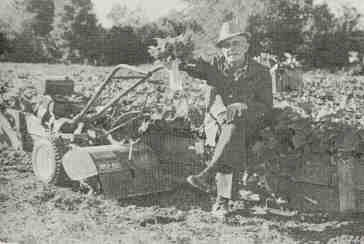 Gleason is know as the sweet potato capital of the United States, and the town
proudly carries the nickname, "Tater Town." The plants grown in Gleason are
shipped all over the United States with an occasional shipment as far away as
Hawaii. Gleason is know as the sweet potato capital of the United States, and the town
proudly carries the nickname, "Tater Town." The plants grown in Gleason are
shipped all over the United States with an occasional shipment as far away as
Hawaii.
The growing and shipping of sweet potato plants in Gleason began back in the
1920's. In the beginning there were only a few shippers or dealers in the sweet
potato plant business. In addition to the dealers who all grew plants,
many farmers in the area grew plants which they then sold to the plant dealers
for shipment. Now, most of the farmers have stopped growing the plants and the
dealers grow their own. The sweet potato plant dealers got most of their
customers by advertisements run in farm magazines.
In the beginning there was only one variety of sweet potato plants grown in
Gleason. That one variety was Nancy Hall. In the late 1920's, however, two
friends of J. D. Bradberry asked him to join with them in ordering some sweet
potato plants from Puerto Rico to be grown for shipment. The first plants
produced potatoes that were firm but not too pleasing to the taste. The men
decided to graft some of the Puerto Rican plants with Southern Yam plants. This
combination produced a potato that was firm as well as pleasing to the taste.
The next step was to find a name for the new potato plant. Some of the names
proposed for the new variety were: Porto Rico-southern yam, Porto Rico-yam, or
Porto Rico and ______. The name finally agreed upon was Porto Rican. The only
place in the world a Porto Rican plant could be purchased was Gleason, Weakley
County, Tennessee. As time went by, several other varieties of plants were
developed until, at the present time, there are some ten to twelve different
varieties grown in the area. Steele Plant Company has worked closely with
experimental stations testing two new varieties of sweet potatoes. These
varieties are the Vardaman, a vineless variety with purple foliage, and the
Georgia Jet, an orange fleshy potato with purplish red skin which produces an
extra high yield.

Sweet Potatoes Shipped by Railroad
Picture Note 1:
Young boy in white shirt (right) - Jimmie Glenn; Man standing on platform - Gale
W. Ray; Lady with suitcase - Rachael Kennon, Man on left side of Truck -
Harry Mac Edwards.
Picture Note 2:
Picture made by Marie and Calvin Wheat, developed by Harles Woodard (Gleason,
TN), received from Laurie Beach Pine, and provided to GleasonOnline.com by
Jimmie Glenn.
------------------------------
Over the years there have been approximately thirty different individuals
operating as plant shippers in Gleason, but some of these have retired, some
have sold out, some have quit, and some have passed away. Today, there are
only two companies in Gleason still shipping plants. They are the Steele Plant
Company, owner Dudley Sanders, and Margrave Plant Company, owner Frank Margrave.
The sweet potato business has provided seasonal jobs for numerous people in the
Gleason area and, of course, put money into the overall economy of our town.
For many years our plants were shipped by Parcel Post and Railway Express. In
addition to this, quite a few plants were shipped by truckloads and many
peddlers from different areas came here to purchase plants. Many large orders
for 50,000; 100,000; or, on a rare occasion, 1,000,000 plants were filled. Of
course, the passenger trains were running when the plants were being shipped by
Railway Express. Also, the Parcel Post shipments were sent from the Post Office
to the railroad station to be transported by the passenger trains. Many times
there were so many plants at the station ready to be loaded on the train that
the train would have to sit in Gleason for as long as 30 to 45 minutes for the
plants to be loaded.
Passenger trains stopped running through Gleason a number of years ago, and the
plants are now shipped almost entirely by Parcel Post and United Parcel Service.
The Parcel Post shipments are picked up by U.S. Mail trucks every week-day, and
the United Parcel Service trucks pick up the plants here five days per week ---
Monday through Friday. Gleason "Growers of Potato Plants" believe that they
started something. One result in evidence is Gleason's United States Post
Office. The tiny third-class post office became a beautiful second-class post
office, because of the sweet potato business in this area.
The method of doing business has changed to where Gleason Plant Dealers do not
even try to get large orders anymore, but make and effort to get as many small
orders as possible. However, it is believed that there are still more mail order
sweet potato plants shipped out of Gleason each year than from any other town in
the nation.

The history of the Gleason community provided in
Oakwood-Gleason: A Look Back provides an account of Gleason's history up
through the time the book was originally published. As some 20 years have now passed since its publication, Gleason Online is providing a "History Update"
feature, for each section of the book, for those wishing to add
important historical information relevant to the Gleason community. Contributions can be submitted via E-mail attachment by
clicking on the "Website Visitor Comments" graphic, provided above.
Historical Note:
Gordon Stoker and the Gleason Switchboard
Hugh Gordon Stoker of the Country Music Hall of Fame Jordanaires, began his
musical career at age eight at Tumbling Creek
Baptist Church, just outside of Gleason. In citing the early influence of his
parents, mom Willie and dad Ambus (known in Gleason as H. A. Stoker), he
states that he was born on August 3, 1924 right
in the middle of Gleason. The place of birth was the old telephone office building where his family
lived. As he tells it, his mother was one of two switchboard operators for the
telephone system and his father was the repairman.
He indicates that his mother was the night time operator, and that "You couldn't make a phone call after 9:00 p.m. or
before 6:00 a.m."
He goes on to indicate that incoming phone calls were completed by means of a "switchboard" that connected
the lines between caller and receiver and notes that calls made after an hour
that was
unacceptably late for phone calls were either not answered or met with the
announcement, "It's after 9:00 p.m." He admits that
"Maybe if it was somebody she knew, she would go ahead and connect them."
Gordon's collection of memorabilia includes an old crank telephone
once worked on by his father.
Source:
Jordanaires.net.
J.
Johnson
[Back]
Home About
UsGleason
BusinessesChurchesGleason
SchoolObituariesPicturesGleason
NewsContact
Us About
UsGleason
BusinessesChurchesGleason
SchoolObituariesPicturesGleason
NewsContact
Us
Copyright
© 2003 - 2007 GleasonOnline.comTM. All rights reserved.
|