|
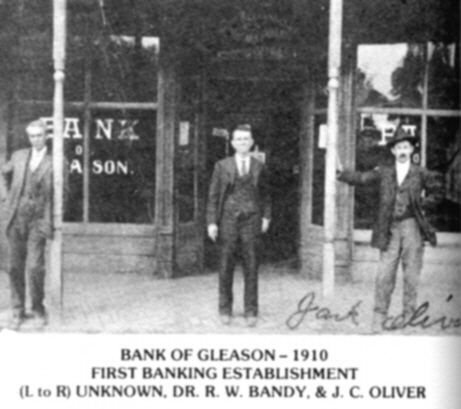 In
1900 men of wealth and influence in Gleason and the surrounding
community recognized the need for a local community bank. With
foresight and visions of better things for the area, three men fostered
a move to organize a bank in Gleason. Their dream was finally
recognized after many months of hard work. On February 25, 1901, the
Bank of Gleason was granted a charter by the State of Tennessee
Banking Department with an authorized capital of $25,000.00 of which
$6,250.00 was paid in. This was historic as there were very few state
banks in the State of Tennessee at that time. This charter of
incorporation was applied for by W. B. Bynym, J. C. Ammons, T. P.
Hodges, J. N. Trantham, A. G. Brummitt, R. W. Bandy, and R. E. Maiden,
all of whom were named to the Board of Directors. In
1900 men of wealth and influence in Gleason and the surrounding
community recognized the need for a local community bank. With
foresight and visions of better things for the area, three men fostered
a move to organize a bank in Gleason. Their dream was finally
recognized after many months of hard work. On February 25, 1901, the
Bank of Gleason was granted a charter by the State of Tennessee
Banking Department with an authorized capital of $25,000.00 of which
$6,250.00 was paid in. This was historic as there were very few state
banks in the State of Tennessee at that time. This charter of
incorporation was applied for by W. B. Bynym, J. C. Ammons, T. P.
Hodges, J. N. Trantham, A. G. Brummitt, R. W. Bandy, and R. E. Maiden,
all of whom were named to the Board of Directors.
The first stockholders meeting was chaired by G. W. Newberry with Guy
Alexander as Secretary. The first official business was a motion to
purchase a lot known as Manley lot for the sum of $150.00. The
building constructed on this site became the first location for the
Bank of Gleason. Jozelle's Beauty Shop now occupies the original
building.
On March 7, 1901, the stockholders met again and voted to raise the
number of directors to 13. The new directors elected were John A.
Paschall, J. L. Smith, G. W. Newberry, T. A. Jones, A. Foust, and Guy
Alexander. A.G. Brummitt was elected President and his salary was
fixed at $200.00 per year. T. A. Jones was elected Vice-President and
Guy Alexander was elected Cashier at a salary of $60.00 per month
"with instructions to look after the committee work."
The Board of Directors met on January 7, 1902 and instructed the
Cashier to "make no loans for less than one dollar charges." At their
meeting on January 2, 1903, a motion carried to "require no service of
the President than absolutely necessary in the way of signing
documents and to pay the President no salary." It was agreed to pay
the Cashier $75.00 per month for his work and "should the business
grow to such proportions that he could not do all the work that he,
at his own expense, procure the necessary help." In those days the
President and Vice-President were inactive and the Cashier was the
active working officer of the bank.
The oldest available record of financial condition was given as
follows: Total loans $49,371.01; Cash on hand and in banks $6,468.08;
Capital Stock paid in $10,000.00; Deposits $61,111.03; and Total
assets of $75,533.28.
On July 8, 1904, A. G. Brummitt offered his resignation as President
and W. B. Bynum was elected President to fill the unexpired term of
Mr. Brummittt. The stockholders voted in January 1905, that they
"favored the Legislature creating the office of State Bank
Examiner."
On March 14, 1907, Guy Alexander offered his resignation as Cashier
and Dr. R. W. Bandy was elected to fill his vacancy. The Finance
Committee allowed Dr. Bandy $125.00 per month for his services as
Cashier and he was to furnish his own help. The Cashier was
authorized that year to issue time deposit certificates and the first
dividend of 5% for the stockholders was declared.
On June 30, 1910 the bank reported that assets had increased to
$107,386.91 with total capital of $24,258.54. During this time, the
Bank of Gleason qualified as a depository for the State of Tennessee,
one of only a very few banks to qualify as such.
In 1914, the Directors of the Bank of Gleason instructed R. W. Bandy,
Cashier to borrow up to $5,000 to be loaned to customers on baled
cotton with not more than $20.00 to be advanced on any one bale and to
be insured with chattel mortgage on cotton.
In 1915, the Bank of Gleason reported that for the first six months of
the year, the bank had paid $9.00 for water tax, $2.45 for building
repairs, $.90 for post office box rent, $9.50 for stockholders dinner,
$3.00 per month for janitor, $2.00 for plumbing, $3.50 for clean
sweep, $30.91 for income taxes, and $1,200.00 for payroll. Total
expenses for the first six months were $1,720.57.
In 1919, as World War I came to an end, the Bank of Gleason
purchases $10,000.00 in Victory Loan Bonds to help the government fund the
war, and the Cashier reported total assets were $226,436.16.
On January 5, 1920, the Board of Directors met at the Opera Hall and
J. C. Oliver was elected President. On January 19, 1920, J. C. Oliver
resigned as President and W. B. Bynum was elected to succeed
him. During that year, the Casher was authorized to to loan "up to
$4,000.00 to handle sweet potatoes."
During 1926, the bank reported that assets had increased to
$240,410.98. The 5% semi-annual dividend continued through these
years.
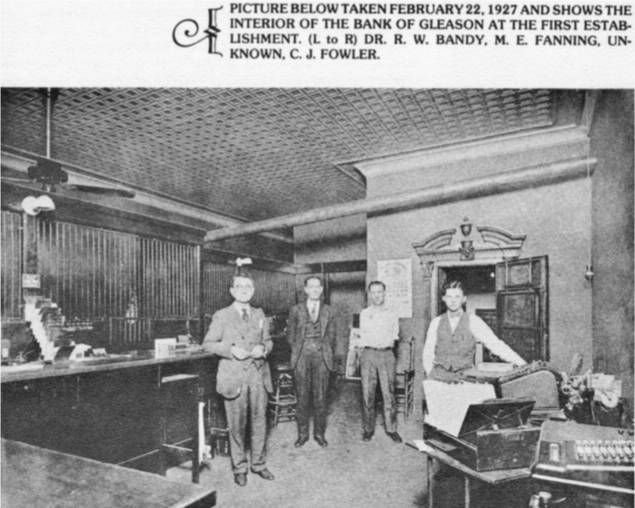
Early in the year of 1930, serious meetings were held relative to a
possible merger with the Farmers & Citizens Bank which had been
organized in 1907 and was reported to be in a sound and healthy
condition. It was noted that such a merger would cut overhead expenses
and increase the capital structure. In a tentative agreement, executed
between the Directors of both Banks, it was agreed that the
merged banks would operate under the original charter of the Bank of
Gleason and would be known as the Bank of Gleason. It was agreed that
the Capital Stock of the consolidated bank would $25,000.00 fully paid
up, with a surplus fund of $25,000.00, and any other assets belonging
to the consolidated bank would be carried as undivided profits. It was
further agreed that the Board of Directors of both banks would
continue until December 31, 1930. Then a new Board would be elected
consisting of nine members, five of whom would be from the
stockholders of the Bank of Gleason and four from the stockholders of
the Farmers & Citizens Bank. It was also agreed that R. W. Bandy be
elected President and that he would devote at least half of his time
to the bank at a salary of $100.00 per month. A.M. Dunlap and M. E.
Fanning were to be the other active executive officers of the merged
bank with equal executive authority and equal salaries. In
order to avoid an amendment to the charter, the par value of of the
stock of the Bank of Gleason was reduced from $100.00 per share to
$25.00 per share fully paid, with the right to issue fractional parts
of shares if necessary. The merger was consummated effective December
31, 1930 with 1,000 shares outstanding under the name of Bank of
Gleason. On January 6, 1931, the stockholders met and elected the
following directors: J. C. Ammons, R. W. Bandy, T. G. Cooper, S. L.
Costen, A. M. Dunlap, J. E. Jeter, John W. Jones, T. A. Lovelace, M.
E. Fanning, S. C, Newberry, Carl Parks, D. F. Terrell and E. A. White.
The new Board of Directors met and elected the following officers: J.
C. Ammons, Chairman: R. W. Bandy, President; Carl Parks,
Vice-President; A. M. Dunlap, Active Vice-President; M.E. Fanning,
Cashier: and C. J. Fowler, Assistant Cashier.
During the year 1931, the Cashier reported that loans and overdrafts
exceeded deposits by $11,000.00. On March 7, 1932, the Directors voted
to cut the shares f the officers by $15.00 each per month for the
balance of the year. With the depression years taking their toll, the
payment of dividends ceased in 1933. On January 5 of that year Dr. R.
W. Bandy retired as Active President of the bank but remained as
President. During the year of 1933. President Roosevelt declared a
Bank Holiday and all banks were ordered to close. They were later
permitted to reopen but were prohibited from making any payment of
gold or gold certificates and only the payment of currency in ordinary
use.
In 1934, the Federal Deposit Insurance Corporation was organized and
each depositor was insured up to $2,500.00. On December 25, 1934, the
Cashier reported "no overdrafts" and rates paid on Certificates of
Deposit were reduced to 2%.
The Cashier reported at the annual stockholders meeting in January,
1937, that total assets on December 31, 1936 were $242,648.29. The
bank was beginning to show an upward trend in growth due to a renewed
confidence in the banking industry. Carl Parks was named President to
fill the vacancy left by the death of Dr. R. W. Bandy.
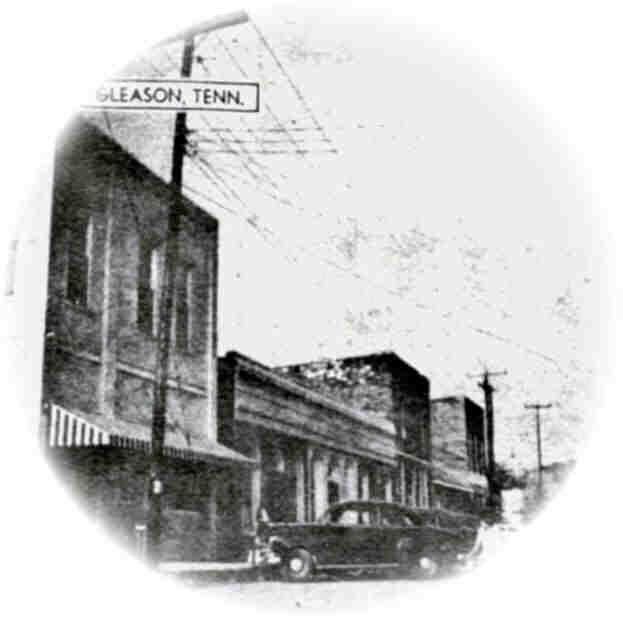
In 1940, after years of disagreement between stockholders and
directors, the bank moved from its original location to the building
formerly occupied by the Farmers & Citizens Bank. The bank remained in
this location, which is across the street from the present location,
until 1963. In 1940 the bank reported assets in excess of $476,000.00.
Until this time the Board of Directors had met in semi-annual
sessions, but as the Bank of Gleason continue to grow the Directors
found it necessary to meet monthly in order to conduct business at
hand. In 1944, the Cashier reported assets of $880,769.60. Also in
that year, the bank was saddened by the death of Chairman J. C. Ammons.
In 1946 the Board of Director voted to close the bank at 3:00 P.M.
rather than 4:00 P.M. On December 31, 1946 total asset reached
$1,258,693.80 At the stockholders meeting in January of 1947, the
Cashier stated that a milestone had been reached, the stockholders now
owing a bank with one million dollars in assets. It was reported by
the Board that a million dollar bank was beyond their wildest dreams.
In 1948 the board of Directors voted to pay a cash dividend of $2.00
per share. Also Directors would be paid $5.00 per month for their
services, however, the Director must be present at each meeting, or
his share would be prorated to those present. The Cashier reported
that total expenses for 1947 were $8,990.49. In 1949, the Board
ordered that the bank remain open during the noon hour, and in 1951
the bank building was remodeled at a cost of $5,708.65. Air
conditioning was added in 1952.
 In 1957 the board elected M. E. Fanning to serve as Executive
Vice-President and R. H. Owen as Cashier and in 1959 the Board voted
to purchase a certain lot across the street from the bank and
authorized a purchase price of up to $2,300.00. In 1957 the board elected M. E. Fanning to serve as Executive
Vice-President and R. H. Owen as Cashier and in 1959 the Board voted
to purchase a certain lot across the street from the bank and
authorized a purchase price of up to $2,300.00.
At the annual stockholders meeting in 1963, it was voted that the bank
should erect a new building and further handling of the project
was left to the discretion of the Directors. On December 18, 1963, the
formal opening of the new bank was held with over 1,500 customers and
friends in attendance, including bankers from West Tennessee and as
far away as Memphis and Nashville.
In 1965, Carl Parks was elected to serve as Chairman of the Board and
R. H. Owen was elected President. The first stock dividend ever
declared by the Bank of Gleason also took place as a 100% stock
dividend was declared. Total assets had increased to over $2.4
million with total capital of approximately $228,000.00.
In 1967, M. E. Fanning was elected to serve as Chairman of the Board.
During the year of 1969, total assets exceeded $4 million and Dr. R.
M. Jeter was elected Chairman of the Board of Directors to fill the
vacancy left by the death of Mr. Fanning.
In 1973 another 100% stock dividend was declared and in 1976 it was
noted by the Cashier that total assets had exceed ten million dollars.
The same year the bank celebrated its 75th anniversary with an open
house which included a treasure chest, a counterfeit display, and
other activities conducted in the bank community room. The
Bookkeeping Department was also expanded and a new bookkeeping vault
was erected in 1977.
During the year 1978, Total assets of the bank increased approximately
two million dollars with a net operating profit of $207,804.58 making
this the most profitable year in the history of the bank.
In 1981, the bank purchased its first "in house" computer system
and it was reported that the bank's assets had crossed the $20 million
mark with approximately $1.7 million in capital.
The Bank of Gleason converted to a full accrual accounting method in
1983 and a third drive-in window was installed. The formation of
BankShares of Gleason Inc., was finalized and new BankShares stock
certificates were issue with the same number of shares outstanding as
the Bank of Gleason. The Board also approved the remodeling of the
bank lobby.
In 1984 R. H. Owen was honored for forty years of service to the Bank
of Gleason. Bob received a gold watch from the bank and an open house
was held in the bank lobby with many area bankers, friends, and
customers in attendance.
At the annual stockholders meeting in 1985, a 100% stock dividend was
voted on and passed. It was also noted that the drive-in window would
be open every Wednesday. The bank purchased a building directly across
the street from its location to be used as a new community room. The
old community room was to be converted to additional office space with
a conference room. It was also reported that total assets of the Bank
of Gleason were $29.5 million with $3.1 million capital.
In addition to the original signers of the charter, the following have
faithfully served the Bank of Gleason as directors since its origin in
addition to the present directors: W. T. Knight, C. A. Brasfield, S.
L. Costen, E. H. Parks, F. P. Simmons, J.C. Oliver, T. G. Cooper, R.
Johnson, J. D. Parks, John W. Jones, A. M. Dunlap, M. E. Fanning, Dr.
J. E. Jeter, S. C. Newberry, Carl Parks, D. F. Terrell, E. A. White,
J. L. Margrave, V. J. Drewry, J. M. Cochran, R. V. Smyth, T. L. Smith
and M. J. Finch.
In addition to original and present officers, the following have
served as officers during the history of the Bank of Gleason: Dr. R.
W. Bandy, W. Polk Alexander, M. E. Fanning, J. C. Oliver, J. C. Ammons,
C. J. Fowler, Carl Parks, A, M. Dunlap, J. E. (Doc) Bell, Carl W.
Parks, V. J. Drewry, James B. Johnson, John L. Johnson, Francis L.
Trantham, John W. Jones, Edith Hunter Griffith and M. J. Finch.
Click Here for Past Presidents of the Bank of Gleason


The history of the Gleason community provided in
Oakwood-Gleason: A Look Back provides an account of Gleason's history up
through the time the book was originally published. As some 20 years have now passed since its publication, Gleason Online is providing a "History Update"
feature, for each section of the book, for those wishing to add
important historical information relevant to the Gleason community. Contributions can be submitted via E-mail attachment by
clicking on the "Website Visitor Comments" graphic, provided above.
[Back]
|