|
Gordon Stoker - "The Amazing Years"
By Deborah Turner
dturner@mckenziebanner.com |
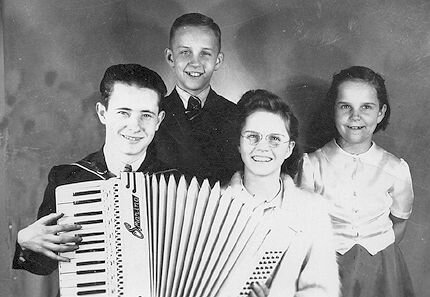
Hugh Gordon Stoker, holding the accordion,
made his debut into the music business as the piano player for the Clement
Trio of Gleason. With Hugh Gordon are little Gloria Clement, Fred, Jr. and
Rachel.
Read Part 1, Gordon Stoker - Gleason's Musical Marvel Makes
it to Nashville,
here.
Gordon Stoker was raised
among a family of musicians in Gleason in the 1930's, a time when singing
conventions were prime entertainment among small southern towns that took
turns hosting the events, giving locals at least one opportunity each month
to enjoy the shows while many ventured to neighboring towns on successive
weekends for the added spice of variety.
One of the most spectacular of the singing conventions was the Snead-Grove
Picnic in McKenzie, where local talent mixed with stars of the Grand Ole
Opry to the delight of enthusiasts who came from near and far to enjoy the
popular event. It was here that 12-year-old piano sensation Gordon Stoker
caught the eye and ear of John Daniel, manager of the famed Daniel Quartet,
who proclaimed his intention to make the boy a star someday.
While members of the Daniel Quartet waited for Gordon to grow up before
whisking him away to Nashville (an act that was set in motion just one week
after he graduated from high school at the age of 15), Gordon set about
promoting his own fame as a member of the Clement trio, the sensational
young group that in addition to Stoker was made up of the Clement children:
Gloria, Rachel, and Fred, Jr.. The hot young trio was an early morning
staple on WTJS radio, listened to regularly in homes where television had
not yet made its debut.
Fans continued to enjoy Gordon's inimitable skills on the piano as WSM radio
in Nashville broadcast the sounds of the Daniel Quartet to homes across
Tennessee. Gordon's success with the quartet was interrupted, however, when
he was drafted into the Air Force in 1943. He served as a Teletype operator
for three years during World War II, then devoted a few years to education -
studying psychology, music and voice - before being drawn back to Nashville,
where the Daniel Quartet was still going strong.
Hugh Gordon Stoker rejoined the Daniel Quartet
upon his return to Nashville, bringing back his special brand of piano
skills that had increasingly thrilled listeners since he was eight years
old. Meanwhile, in Springfield Missouri, a new quartet, The Jordanaires, was
formed in 1948 by Bill and Monty Matthews along with bass singer Culley Holt
and second tenor Bob Hubbard.
The following year The Jordanaires were in Nashville, having
been hired by the Grand Ole Opry. Then, once again, the draft changed the
face of music when the group's original piano player, Bob Money, was
drafted.
Gordon auditioned among competition like Boyce Hawkins and Marvin Hughes,
both of whom later played for The Jordanaires from time to time, Hawkins
filling in as needed and Hughes playing for the group during Grand Ole Opry
shows.
Gordon won the audition, becoming the group's piano player in 1950, the same
year he met his wife, Jean, at a singing in Nashville.
"We had a church singing every second Tuesday; it was a big singing," Gordon
shared, recalling once more the affairs that filled weekends everywhere with
music.
"She loved to sing gospel songs and I loved to play them," he continues by
way of explaining the attraction that grew between the young couple. As a
member of the Wilkerson Trio, along with her sisters Mildred and Edna, Jean
was also a performer at the singing where she met Hugh Gordon, finally
meeting the young man whose music she had enjoyed since both were children.
"She had listened to me play as far back as 1942. People listened to the
radio every morning before work," he says, explaining again the differences
in the era before television was a widespread source of entertainment and
information. When Gordon and Jean married on September 9, 1951, The
Jordanaires sang "Tell Me Why" at the wedding with Boyce Hawkins at the
organ.
In 1952, Gordon's career shifted suddenly and dramatically when first tenor
Bill Matthews was unable to perform during the first evening of an
engagement at a supper club in Detroit, Michigan.
"Hoyt Hawkins came to play piano," says Gordon, who was forced that evening
to assume the role of first tenor at a moment's notice. More changes were in
store for the group when Bob Hubbard was drafted, with Neil Matthews (no
relation to the former Matthews brothers) taking the second tenor position
in 1953.
For 47 years, from 1953 through 2000, the group's membership was almost
constant with Gordon Stoker at first tenor, Neal Matthews as second tenor,
and Hoyt Hawkins as baritone. Their joint tenures were interrupted in 1982
when Hoyt passed away with the baritone position then filled by Duane West,
who died last year. In the bass position, Ray Walker filled Hugh Jarrett's
position (who had replaced Holt in 1954) in 1958 and continues to present.
The quartet is currently composed of first tenor/manager Gordon Stoker,
second tenor Curtis Young (who filled Neal's position when he died in 2000),
baritone Louis Nunley (who took Duane West's place) and bass Ray Walker.
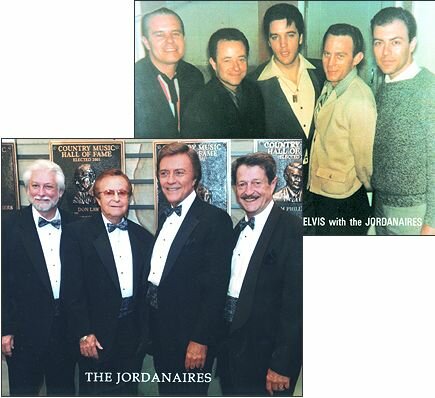
In 1955, The Jordanaires traveled to Memphis to sing with Eddie Arnold at
Ellis Auditorium, the historic and architecturally rich edifice that,
unbelievably, was razed last year to make room for the expansion of the
Memphis Cook Convention Center.
When the show was over, a young musician who was working hard at earning his
own success went backstage to meet The Jordanaires. He told the group that
if he ever got a major recording contract he wanted them to sing with him.
At the time he was recording on the Sun label, a recording company now
famous as "the birthplace of rock and roll." In addition to Elvis Presley,
the label recorded such legends as Johnny Cash, Jerry Lee Lewis, and Carl
Perkins as well as Roy Orbison, Charlie Rich, Bill Justis, and Harold
Jenkins (now known as Conway Twitty.)
The only thing that made the young man memorable at the time, Gordon says,
was his long sideburns.
"Boys didn't have long sideburns back then," he explains, "But the main
thing was that he had on a pink shirt. Boys just did not wear pink shirts in
1955."
The young gentleman was none other than the prince who would become the King
of Rock and Roll, his pink shirt and sideburns just a sampling of the ways
he would shake up the world with his new brand of music.
"Elvis had heard us sing on the Grand Ole Opry's Prince Albert Show; we
would always sing a fast-moving spiritual and that's what he liked," says
Gordon, who says Presley had wanted to join a quartet himself and had
auditioned for two groups in Memphis but was turned away.
Gordon later ran into one of the quartets who had turned away the King and
asked, incredulously, "You turned down Elvis Presley?"
"We had to," was the reply, "You give Elvis one part and before you know it
he's singing another part." Singers within a quartet must be very
disciplined within their assigned roles, Gordon explains, lending insight to
the astonishing harmonics of The Jordanaires.
True to his word, Elvis called the group in January 1956 after signing on
with RCA Records, beginning a relationship that would last nearly 15 years
and a friendship that would last even longer.
Gordon sang duets with Elvis on hit records like "All Shook Up", "Good Luck
Charm", and "Easy Come Easy Go" while the full quartet sang back up on most
of Elvis' songs.
Gordon pulls out a CD containing 30 of Elvis' number one hits. "We're on 24
of them, that gives you an idea of how many we did," he says. He's wrong.
While the ratio may be right, the numbers don't compare, with The
Jordanaires performing on an astounding 361 records with the King, not to
mention 28 of some 31 Elvis movies.
Memories of the Elvis years come easy for Gordon, his recollections aided by
more keepsakes in what may best be described as a trophy room, were it not
for the fact that the mementos displayed are not meant to boast but to
remember and honor. In the same room with his childhood keepsakes - his
mom's guitar, his brother's banjo, the church organ of his youth - are the
vibrant photos of a lifetime of music alongside Elvis and other great stars
of country, gospel and rock and roll.
There's The Jordanaires with Elvis, taken at 7:00 in the morning after
recording all night in Studio B in Nashville; a scene from the set of Elvis'
- and the Jordanaire's - first movie, "Love Me Tender", and a collage of
scenes from four other movies: "King Creole", "Loving You", "Jailhouse Rock"
and "G.I. Blues", and memorable early photos of Elvis performing on the Ed
Sullivan Show.
There's even a custom made jacket Elvis once wore, authenticated by its
label, with accompanying photos of the King performing in the coat.
One of Gordon's favorite memoirs is a metal wall hanging he first spied in
an overseas restaurant, perhaps Amsterdam, that shows a close up of an early
Elvis with undyed, sandy hair, and smaller inserts of an airplane and an
older model vehicle. None of the components make sense, says Gordon, trying
to reconcile the pieces into a coherent whole.
It was some time later when the hanging fell into Gordon's hands when he
received a phone call one day. "I'm downtown in Nashville," said the
accented voice of the restaurant's owner, "I brought a present for you."
Emblazoned across the top of the collage are the words "The Amazing Years",
which alone give credence to the components; whatever they were, they came
together to create truly remarkable years. The same can be said of The
Jordanaires' amazing years, with over 50 years of continuous demand for the
singers' vocal talents giving testimony to their tremendous versatility and
awesome skill.
Besides Elvis, there are photos of many other artists with whom The
Jordanaires have performed: Patsy Cline ("We loved, Patsy, didn't
everybody," Gordon sighs), Tennessee Ernie Ford, Ricky Nelson, Roy Orbison,
Connie Frances and George Jones. The photos get newer and gain color as the
years progress on The Jordanaires own "wall of fame", with Vince Gill, Steve
Warner, the Judds and Tanya Tucker just a few of the contemporary artists
with whom The Jordanaires have performed. The most recent estimate of
recordings sales using the The Jordanaires' for background vocals is 2.6
billion.
But The Jordanaires are performers in their own right, as well, their
discography reflecting continuous releases from 1950 to the present. Their
honors include:
* 1998: Gospel Music Hall of Fame
* 1999: North America Country Music Associations International Hall of Fame
2000: Rockabilly Hall of Fame
* 2001: Country Music Hall of Fame
* 2002: Golden Voice Awards Vocal Group of the Year
* 2003: Grammy for Best Southern, Country, or Bluegrass Gospel Album ("We
Called Him Mr. Gospel Music: The James Blackwood Tribute Album" with The
Jordanaires, Larry Ford and The Light Crust Doughboys)
Their voices are heard on Coca-cola's ad, singing "We'd Like to Teach the
World to Sing" and are those of the singing portions of the 1990 animation
"Rock a Doodle".
Nowadays, after 53 years in the music business, The Jordanaires remain in
great demand, singing back up for various artists plus performing Elvis
tributes with Scotty Moore, Elvis' original guitarist, and D.J. Fontano, his
original drummer. Most recently, The Jordanaires performed last weekend in
Jackson with Elvis Wade, one of the most famous Elvis impersonators.
Gordon remembers Elvis with a fondness reserved for family. "He was a great,
super nice guy," he shares, "much too good for his own good. He was always
in a good mood; he always had a good attitude - there's nobody that had a
good attitude like Elvis. He was one of us; he considered himself one of the
group, and he was an inspiration to be around; he made the best of any
situation. In 15 years he never blew up and, believe me, he should have. His
mother raised him that way, to make the best out of any situation... most of
the time you can't do anything about it anyway."
It was Elvis' good nature, Gordon says, that allowed people to take
advantage of him in everything from the songs he sang to his appearance. "We
used to tell him, man if you don't want to do it, don't do it," Gordon
declares, "But he would say, 'No, I'd rather do it than argue with them."
The Jordanaires left Elvis when it was decided he would do two shows a night
in Las Vegas. "I always thought two shows a night is what took his life,"
Gordon says sadly, "It's just hard... They pushed him, he wasn't well; he
was taking uppers and downers all the time. He was never on hardcore drugs -
he didn't even smoke marijuana - but that eventually took his life."
In their spare time, Gordon and Jean enjoy spending time in Florida. "We
love the auto races," Gordon says. Until recently the Stokers enjoyed
boating as well, the two house boats they enjoyed over 17 years each named "Sugaree"
after the 1957 Jordanaires hit which was written by Marty Robbins.
For most of the year, the Stokers live in their home state of Tennessee in
lovely Brentwood just outside Nashville. Their spacious home is located on
what was once pastureland of T.G. Shepphard's ranch in a music community
that is rapidly growing.
The Stokers have two sons - Alan and Brent - and a daughter, Venita, plus
five grandchildren. Gordon's first cousins Merle Penick and Lozette Burrow
still live in McKenzie while his brother Wayne is well known in Gleason.
And while Gordon is reminiscing about old times and old friends, they are
remembering him as well. Wanda Clement of McKenzie is the widow of Fred
Clement, Jr. of the Clement Trio. Now 71, Gloria Clement Lott lives in
Bartlett, TN where her son says, "She can still captivate the audience or
should I say, 'congregation' at the Ellendale Baptist Church where she
faithfully attends with her husband of 52 years."
Says Gloria, who is the last remaining member of the Clement Trio besides
Gordon, "I thought he was the best piano player in the world, too. He used
to sit me up on the bench at the piano and teach me my part along with my
mother. I just loved him to death. We just had a great time singing; when he
left our world just left."
For more information about The Jordanaires, see their website at
www.jordanaires.net and listen to them, like old times, on WSM Radio, 650
A.M. "on your radio dial." Source:
The McKenzie
Banner
Click Banner for McKenzie Banner Features Page

[Home] [About
Us][Area
Businesses][Churches][Photo
Gallery][Contact
Us] [About
Us][Area
Businesses][Churches][Photo
Gallery][Contact
Us]
Copyright
© 2002 - 2005 GleasonOnline.comTM. All rights reserved.
|