| |
|
Gordon Stoker - Gleason's
Musical Marvel Makes it to Nashville: Part one of
a two-part series By Deborah Turner
dturner@mckenziebanner.com |
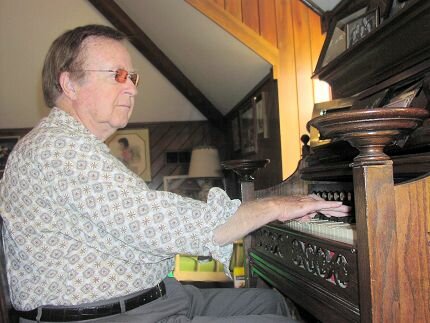
Gordon Stoker plays the organ, lovingly
restored, that he played when he was eight years old during services at
Gleason's Tumbling Creek Baptist Church. By the age of 12, he was playing
piano for the Clement Trio and at 15 was pianist for the John Daniel Quartet
of Grand Ole Opry fame. In 1950 he became a member of the Jordanaires, a
move that eventually propelled him into the Country Music and Gospel Music
Halls of Fame.
Gordon Stoker, whose Tater-town
roots stretch all the way to Nashville, still keeps cherished keepsakes of
his youth. His mother's old guitar rests alongside his brother's banjo in a
corner of a room brimming with mementos of days gone by; along one wall is
the beautiful, richly grained, solid walnut organ he played - beginning when
he was just eight years old - at Tumbling Creek Baptist Church outside
Gleason. The old Kimball organ was made for a time when electricity was
scarce, at best, with thick pedestals on either side of its frame providing
a base from which coal oil lamps once offered dim light during church
meetings held after the light of day had passed into the shadows.
These were the days when good weather brought fine entertainment to rural
demesnes in the form of country and gospel singings that were held at
locations not too far from the beaten path. In McKenzie, the Snead Grove
Picnic attracted throngs of merry-makers as did the weekly singing
conventions that were held every first Sunday in Paris, every second Sunday
in McKenzie at the high school gym, and successive Sundays at Huntingdon and
Dresden.
"We used to have a lot of singing conventions. My mother and dad were hung
on them; we'd go to Fulton, Martin..." recalls Gordon, or Hugh Gordon, as he
was known among singing circles as the young and talented piano player for
the Clement Trio.
Gordon credits his parents - mom Willie and dad Ambus (known locally as H.A.
Stoker) - with his early immersion in music. Music was an important part of
the Stoker family in which each member of the family played a musical
instrument and was provided with lessons outside their home.
Gordon had been born on August 3, 1924 "right on the main drag in Gleason"
in the telephone office building where his family made their home, as his
mother was one of two operators for the telephone system and his father was
the repairman.
"My mother was the night time operator," Gordon says, a grin spreading
across his face as he recalls, "You couldn't make a phone call after 9:00
p.m. or before 6:00 a.m."
Incoming phone calls were completed by means of a "switchboard" that
connected the lines between caller and receiver. Calls made after the hour
deemed unacceptably late for phone calls were either unanswered or met with
the announcement, "It's after 9:00 p.m."
"Maybe if it was somebody she knew, she would go ahead and connect them,"
admits Gordon, whose collection of memorabilia also includes an old crank
telephone once worked on by his father.
As a pianist, Gordon's talent was challenged by the skills of another piano
player who frequented the local singing conventions: "She added stuff to her
music," Gordon says in tones that still reflect the awe that inspired him to
go home and duplicate her efforts, practicing tirelessly beyond the
limitations of his education.
His endeavors paid off for the trio whose fame continued to grow.
"We had a hot trio, believe me," recalls Gordon, declaring, "We'd stop the
show anywhere we'd go!" Vocalists for the trio were the Clement children:
Gloria, age 8; Rachel, 12, and Fred, Jr., who was 10 years old. At age 12,
on the piano, Gordon was red hot - so hot that a performance at the Snead
Grove Picnic garnered the attention of Mr. John Daniel of the immensely
popular John Daniel Quartet, just one of many country acts of the late
1930's that were brought to the picnic from the WSM radio station and the
Grand Ole Opry.
He grins as he recalls his first step toward fame: "John Daniel, manager of
the group, heard me play, and said, 'Son, how old are you?'"
After confessing he was only 12 years old, he recalls, Mr. Daniel vowed, "I
want to bring you to Nashville; I'm going to make a star out of you!"
Hugh Gordon was already a star in West Tennessee, where early morning radio
shows on WTJS in Jackson made "The Clement Trio" a household name. He
chuckles as he relates a phone call he received, about two years ago, from a
"lady from McKenzie" who was passing through Nashville and called to ask if
he was the same Hugh Gordon Stoker who once played for the Clement Trio.
She fondly recalled - some 60 years later - the memorable way Mr. Clement
introduced his role with the group: "He's not a banker, he's not a broker,
he's just the world's greatest piano player, Hugh Gordon Stoker!"
"Lot of people who knew me years ago still call me Hugh Gordon," he admits,
counting Minnie Pearl among that group after becoming one of the Grand Ole
Opry's youngest performers at the age of 15 when, true to his word, John
Daniel called a week after his graduation from high school and invited him
to join the quartet.
Clement Trio fans continued to enjoy Gordon's skills through the 50,000
watt-powerful WSM radio station that reached every morning into homes as far
away from Nashville as Carroll and Weakley counties. Hugh Gordon was a great
success, but World War II was raging, and Uncle Sam was calling his children
from every walk of life to partake in the battle against evil that
threatened the very freedom Gordon so amply enjoyed. In 1943, he was drafted
into the United States Air Force.
Dismayed by the interruption of his career, Gordon was nevertheless aware of
his great fortune when a typing test - in which he excelled - earned him the
job of teletype operator. Stationed in Brisbane and Ipswich in Australia, he
worked in the airport's control towers, using teletype to monitor air
traffic.
"I had a good deal; not very many men in the early '40's knew how to type,
so I was really lucky, believe me," relates Gordon, obviously respectful of
fellow servicemen whose job descriptions landed them more certainly in
harm's way.
After three years in the military, Gordon moved to Oklahoma near family
members, enrolling at Oklahoma Baptist University where, for two years, he
studied psychology, later changing his focus to music and voice.
"I just wasn't pleased not being back in Nashville," Gordon says decidedly.
The Daniel Quartet was still going strong on WLAC, another 50,000 watt
station. In the latter part of 1948, he decided to return home to Nashville,
where he continued his studies at Peabody College, though his education was
aborted short of achieving a degree.
Gordon picked up where he had left off with the Daniel Quartet until, about
a year later, opportunity knocked when the Jordanaires came to town. In a
move that would propel him into fame unforeseeable at the time, Gordon
auditioned successfully to become the new pianist for the quartet. In the
next few years Gordon would meet his wife as well as a young man in a pink
shirt who would change the course of his life forever: Elvis Presley.
Source:
The McKenzie Banner

[Home] [About
Us][Area
Businesses][Churches][Photo
Gallery][Contact
Us] [About
Us][Area
Businesses][Churches][Photo
Gallery][Contact
Us]
Copyright
© 2002 - 2005 GleasonOnline.comTM. All rights reserved. |