|

TaterTownOnline.com
Weakley County Chamber of Commerce

Anniversary Coins
Gleason Library
Woody (Pat) Dewberry

View Pat's New Book
1950's & '60's Gleason Humor



Tennessee Vacations.com



| |
|

The Life and Times of Mr. Roy Travillian
By Ernie Smothers
smothers@mckenziebanner.com |
| |
|
It has been said
that effort constitutes the defining line between those who dream and
those who achieve. Gleason’s Roy Travillian is an achiever. He has not
only dreamed great dreams, but through hard work and diligence, nurtured
those dreams into reality. A spiritual and earnest man, he has lived a
life that casts shadows on most. Laborer, farmer, salesman, business
owner, college graduate at 68, author—-it’s easier to state what he hasn’t
done rather than list all that he has accomplished. Quick to smile and
even quicker to wit, Roy Travillian is a man with a story to tell.
 |
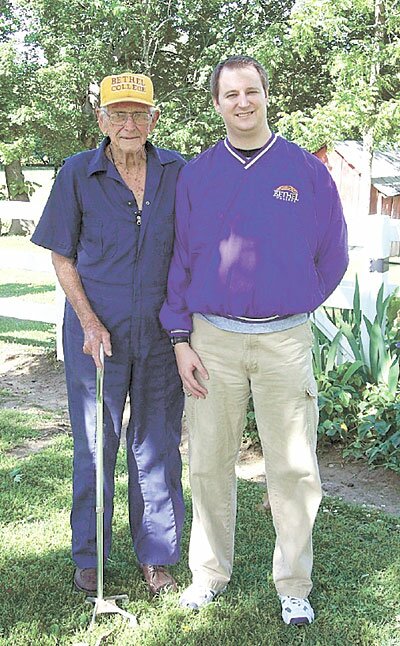
Roy and his grandson, Jamie Roney, who lives next
door. |
Parents
Roy’s mother and father, Elbert and Daisy Dean Hughes Travillian were wed
on December 3, 1902 in the town of Piggott, Arkansas.
Elbert, a hard working and resourceful man, purchased 80 acres of
land that joined his grandfather’s homestead. Clearing the land of large
red and white oak and poplar trees, He planted successful crops of corn
and cotton.
A good financial manager, Mr. Travillian saved money earned by his
labor and reinvested to build a new home and stock barn.
Tragedy struck on a spring night in 1912 when the barn, livestock,
hay and corn were totally consumed by fire. Sadly, no barn insurance was
available at the time. Not inclined to give up, “Ebb” Travillian pooled
his limited savings and purchased two mules. Motivated, he soldiered on,
selling timber from the property and planting crops, until he recouped his
loss and regained prosperity.
New Baby
Born on March 24, 1914, Roy was the fifth child born to the couple.
He said, “The day that I was born, Mama had three boys and one girl at the
time, and every one of them had the measles.”
In June of 1914, tragedy struck the Travillian family again when a fierce
storm destroyed their entire crop. “I was only a couple of months old at
the time, but I remember hearing my family talking about it when I was
older. The storm didn’t take down the house, but it took the crop,” he
said.
After the storm, the family decided to leave Piggott. Mr. Travillian made
hoops to cover his wagon, packed up his family and worldly belongings, and
began the journey toward Tennessee.
Ferry Ride.
Arriving in Caruthersville, Missouri, on the second day of travel, the
family camped that evening on the banks of the Mississippi River.
Early the next morning, aboard their heavily loaded two mule drawn wagon,
they boarded a ferry to cross the river to Tennessee. Half way across, the
ferry’s motor quit, causing the vessel to float downstream for nearly 12
miles. That evening, a small tug boat assisted in pushing the ferry to the
shore, where the captain secured the vessel to a tree. Unable to safely
leave the barge, the family and livestock spent a cold September night on
the Missouri bank of the Mississippi river. With no way to build a fire
aboard the ferry, Mrs. Travillian opened canned fruit to feed her family.
|
|
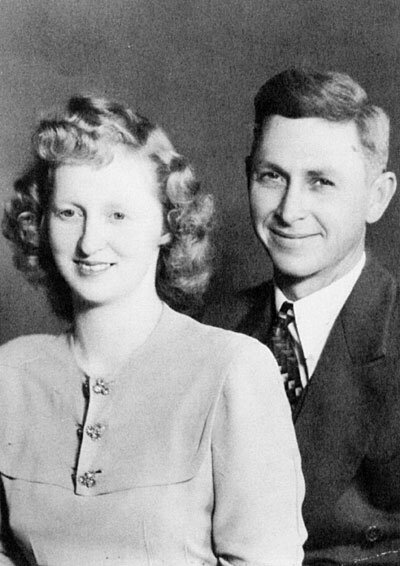
Roy and his beloved wife, Elizabeth. |
The next morning, a large tow boat
hooked to the ferry and transported it back to the original starting
point.
After repairs were made, the vessel transported the family to
Tennessee.
After seven days travel, the family arrived in Dresden and camped
overnight in Mr. Travillian’s uncle and aunt’s yard. The next day, he
purchased a home for $400 with a crop still in field. Enlisting his sons,
he harvested the crop. Utilizing the proceeds derived from the sale of the
crop, he was able to not only purchase the home and land in full, but hay
and corn to feed his stock until the next year’s harvest.
Tornado of 1917
Though only two and a half years old, Roy remembered the tornado
that descended on Dresden in May of 1917. He recalled, “It was hot that
day and my father stood at the back door and watched the clouds. He had
mother on alert. All at once he told her to bring all the children and go
down to the big gully. He and my brothers stayed at the house. He said he
saw trees up in the air to the south of us. He told mother to take us to
the house because it was going to hail. It sure did—-as large as golf
balls. It beat our garden all to pieces.”
Shortly after the storm had passed, a neighbor ran up the road to
their home and informed the family that the storm had hit a neighbor’s
home and they were in need of help. Mr. Travillian and his sons
immediately lent their assistance in freeing the family from the rubble of
their house.
Roy recalled, “The tornado tore our corn stalks right out of the ground
and removed the loose dirt. All the brush in the gully was spread out in
the field.”
That fall, Mr. Travillian sold the farm at the behest of his homesick
wife, who had just given birth to the family’s sixth child, a boy. Roy
recalled that his mother, sister, baby brother and he rode the train back
to Arkansas while his older brothers and father made the trip in two
wagons. The farm, purchased for $400, sold for $5,000.
One year later, Mr. Travillian took a train trip to Tennessee to scout for
a new farm and home. In short order, he purchased an 80 acre farm near
Gleason, half of which was filled with expensive white oak timber.
Summoning his family, the Travillians made their final move to Tennessee.
Roots in Tater Town
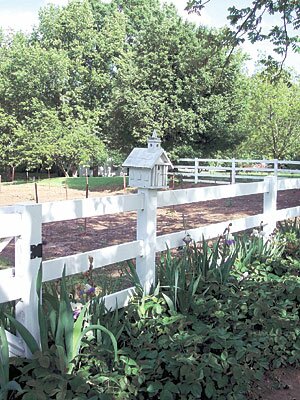
The Travillian's yard shows the fruits of Roy's
labors. |
|
Roy began his third grade school year
at Gleason School, and attended there until graduating high school in
1933.
After graduation, he found work on a farm belonging to Mr. Calvin
Terrell, making one dollar a day with board. The hours were long, from
sunrise to sunset, six days a week. “I was young and healthy back then, so
I didn’t mind.”
The wallet
One day, while working for Mr. Terrell, one of Roy’s fellow workers
was severely injured. He said, “Mr. Terrell hired a man to help work the
hay. I was driving a wagon what had two fiery mules and they were getting
out of control. The new man was sitting on the side of the wagon with his
feet hanging down, and a wheel ran over a stick, causing it to fly up and
knock a hole through his leg.” He continued, “We stopped and carried the
man to the house because he couldn’t walk. Mr. Terrell handed me his
billfold and told me to take the man to the doctor and stay with him as
long as I needed to and take the man home as he would not be able to
work.”
Roy said that he only looked into the billfold when he was paying
the doctor. It was full of ten, 20, and 50 dollar bills. “He could have
sent one of those bills with me and it would have been enough. He knew how
much money was in that wallet, and was trying me.”
Upon arriving back at the Terrell farm several hours later, he immediately
returned the wallet and went back to work hauling hay. The next day, Roy
was given the best job on the wagon in the field. After hay season ended,
he went to McKenzie and began work as a salesman for Ward Coffee Company.
He fondly remembered that Mr. Terrell came to visit him many times before
his death a year or so later.
 Road
Salesman
Beginning July 4, 1935, Roy began running a sales route for Ward
Coffee, earning an impressive salary of $12 a week. “I worked six days a
week from daylight to dark. I was good at selling on the road.”
Saving his money, Roy purchased a brand new 1938 Chevrolet. He
laughed, “It was no-frills—-no extras, no heater.”
It was during that time that Roy met Mary Elizabeth Owen. “She
played basketball for Gleason, and when I bought my car, I looked her up.
By 1940, we were going real steady.”
Draft Board
On December 8, 1941, one day after the Japanese had launched a
deadly surprise attack on Pearl Harbor, Roy received a letter from the
military informing him that he had been drafted. “The draft board
classified me as 1-A, and ordered me to report to a doctor for a physical.
I’d never been to a doctor before.”
The examination revealed that Roy’s heart was beating at 120 beats
per minute, twice the normal pace. Two days later, the draft board sent me
a card classifying me as 4-F.
Learning that Wolf Creek Arsenal in Milan was hiring, Roy immediately
applied for a job and was hired on the spot.
He recalled, “You were actually classified as a military employee if you
worked there, so the next thing I knew, I received another letter from the
draft board informing me that I was re-classified as 1-A.”
Ordered by the military to undergo a second physical, Travillian traveled
to Jackson to Dr. Fitts’ Clinic in Jackson. The initial exam by Dr. Fitts
also revealed a super-fast heart rate. “The doctor told me to relax for a
while and he would re-check my heartbeat. I guess I got too relaxed and
went to sleep.” While Roy was dozing, the doctor again checked his pulse.
“It was still 120 beats per minute. Three days later, the draft board sent
me another letter telling me that they had changed my classification back
to 4-F.
A member of the draft board told me to go back to work at the
arsenal. I never heard from them again.”
The Marrying Kind
Following a three year courtship, Roy and Mary Elizabeth were wed on
January 13, 1942.
At the time, Roy, employed as a guard at Wolf Creek, was working seven
days a week on swing-shift. Mary Elizabeth was employed as a teacher at
Liberty Four in Henry County.
March third, 1944, serves as a day of remembrance regarding two major
events in Roy’s life: the birth of his first child and the huge plant
explosion at the Milan Arsenal.
He recalled, “I wasn’t at work that day. I took the day off to be with my
wife who was giving birth to our first child, Lynda.”
In time, the Travillian’s also welcomed children Carolyn (February 15,
1946), Beverly (August 22, 1946), and Bobby (March 13, 1951) to their
family.
Switching Gears
At the conclusion of World War II, Roy was laid off from the Wolf Creek
arsenal. “I was glad of it,” he reflected.
Seeking employment, Roy was hired by McKenzian Red Summers as a wholesale
candy salesperson. “I was making good money at that job, $100 a week. I
worked there for five years.”
In 1956, Roy was hired by good friend L. D. Folks, owner of Grapette
Company, and given the opportunity to manage one of the company’s bottling
plants located in Bardstown, Kentucky.
Roy was informed that the plant had been poorly managed in the past and
that Mr. Folks wanted to revive the plant in order to sell it. If
successful, Roy was to receive 25 percent of the sale. After much thought,
he accepted the proposal. Working tirelessly, Travillian was able to
restore the company’s sales and reputation. The plant was sold in
December, 1956. Ready to move, the Travillians returned to Gleason in
January 1957.
Company Man
Immediately upon moving back to Gleason, Roy acted upon his desire to
start his own business. Purchasing a panel van to serve as the operation’s
delivery vehicle, and seasoned by years of sales and management,
Travillian traveled to Martin to speak with Fuller Brothers candy
suppliers regarding acquisition of supplies. While there, he also secured
a direct shipment deal with Planter’s Peanuts. A deal with Bradley
Manufacturing was also secured in short order.
Enlisting the help of Bank of Gleason banker and brother-in-law Bob Owen,
Roy sent letters to 14 distribution companies requesting they provide him
with direct shipment of their products. Many of the companies agreed,
solidifying his company’s supply requisition line. Owen also provided
Travillian with a rating on Dunn and Bradstreet.
Remembering the business’ early days, Roy said, “I started out by placing
small, minimum orders and borrowed a small amount from the bank to pay for
the supplies. During that time, my wife got a job at the bank which kept
the house going while I built up the business.”
Working diligently, Travillian expanded his operation rapidly. “I
developed a large sales route and even hired others to help me sell, but
none of them could sell like me. I did well.”
Later, Mary Elizabeth taught fifth grade at Gleason while Roy traveled and
sold his wares. Amazingly, the couple helped four of their children and
two sons-in-law attain college degrees, all at the same time.
Roy said that the next twenty years of his life passed by rapidly. “We
worked all the time, and it was a family effort. Outside of the business,
the only thing we had time for was church.”
Higher Education
Selling his business and retiring in 1976, Roy decided that it was time
for his continue his education.
“I started taking Bible courses at Bethel College. One of my teachers
encouraged me to get my degree, and I did.” He graduated in June of 1982
with a Bachelor of Science degree in Social Studies.
While there, another teacher encouraged Roy to write stories regarding
some of the events that had occurred during his life. The result was Roy’s
Tales, a truly fascinating book that was copywritten and published, and
distributed in December, 1994. As a result of his endeavor, Bethel
bestowed upon him an honorary doctorate degree.
Gardening Grandfather
Grandson Jamie Roney, who is employed as an admission counselor at Bethel,
lives with wife Jennifer in a home adjoining Roy’s property. Jamie said,
“My wife and I often hear Granddaddy start up his tiller early in the
morning.” Smiling, he continued, “He’s 92 years old and still does his own
tilling and gardening, and always has a great crop of tomatoes.” An avid
flower gardener, Roy’s yard fence line is home to a beautiful array of
healthy, colorful plants.
Watching grandfather and grandson interact, their fondness for each other
is unmistakable.
Smiling, Roy reflected, “When Jamie was little, he lived in Alabama. Every
time he would come to visit, I’d take a whisk broom and pretend to sweep
all that bad Alabama dirt off of him.” He added, “Before he would leave to
go home, we would blow up paper bags so he could have some “Tennessee air”
to take home with him.”
Known for purchasing the first Bethel basketball season ticket every year,
Roy shows only subtle signs of slowing down. Despite the loss of beloved
wife, Mary E., on June 29, 2004, Roy continues to live each day with faith
and purpose.
Inspiration for All
One could learn a great deal by examining the life of Roy Travillian. In
an age where complacency at work and home is swiftly becoming the accepted
norm, he stands as a reminder of different days; when persistence, hard
work, dedication to family and God, sacrifice for others, and an unbridled
spirit of self reliance defined the American working man. Let us hope that
he is not the last of his kind, for the world would be far less without
the likes of him. Source: McKenzie Banner.
Home About
UsGleason
BusinessesChurchesGleason
SchoolObituariesPicturesGleason
NewsContact
Us About
UsGleason
BusinessesChurchesGleason
SchoolObituariesPicturesGleason
NewsContact
Us
Copyright
© 2003 - 2006 GleasonOnline.comTM. All rights reserved.
|
|
